
ep 03 field notes
Show Us Your Agent Skills / EP 03 / guest dossier
VINCENT WARMERDAM MARIMO SHARED CANVAS LIVE NOTEBOOK STATE HUMAN UNDERSTANDING

VINCENT WARMERDAM

Vincent shows notebooks as a shared canvas for human understanding and agent work. The notebook exposes live state, interactive controls, docs, and runtime variables so the human and the coding agent can act on the same running system. Wiggly Stuff supplies the interactive widgets, marimo keeps the surface reactive, and marimo pair gives the agent access to variables and controls.

EP 03 · VINCENT WARMERDAM · notebooks as a shared canvas for humans and agents

THE SHARED CANVAS

marimo pair gives the agent the running Python state

Vincent draws pixels in a Paint-like widget, Python reacts every second, then the same surface becomes Conway's Game of Life. A straight line and an arc produce different growth. He changes the system and watches the system answer.

marimo pair puts the agent on that same surface. In the slider demo, OpenCode can read the live Python variables, inspect the current slider value, and change the UI control from the notebook scratch pad.

Wiggly Stuff supplies the interactive pieces, marimo keeps them reactive, and marimo pair gives the coding agent access to the runtime state Vincent is using to understand the system.
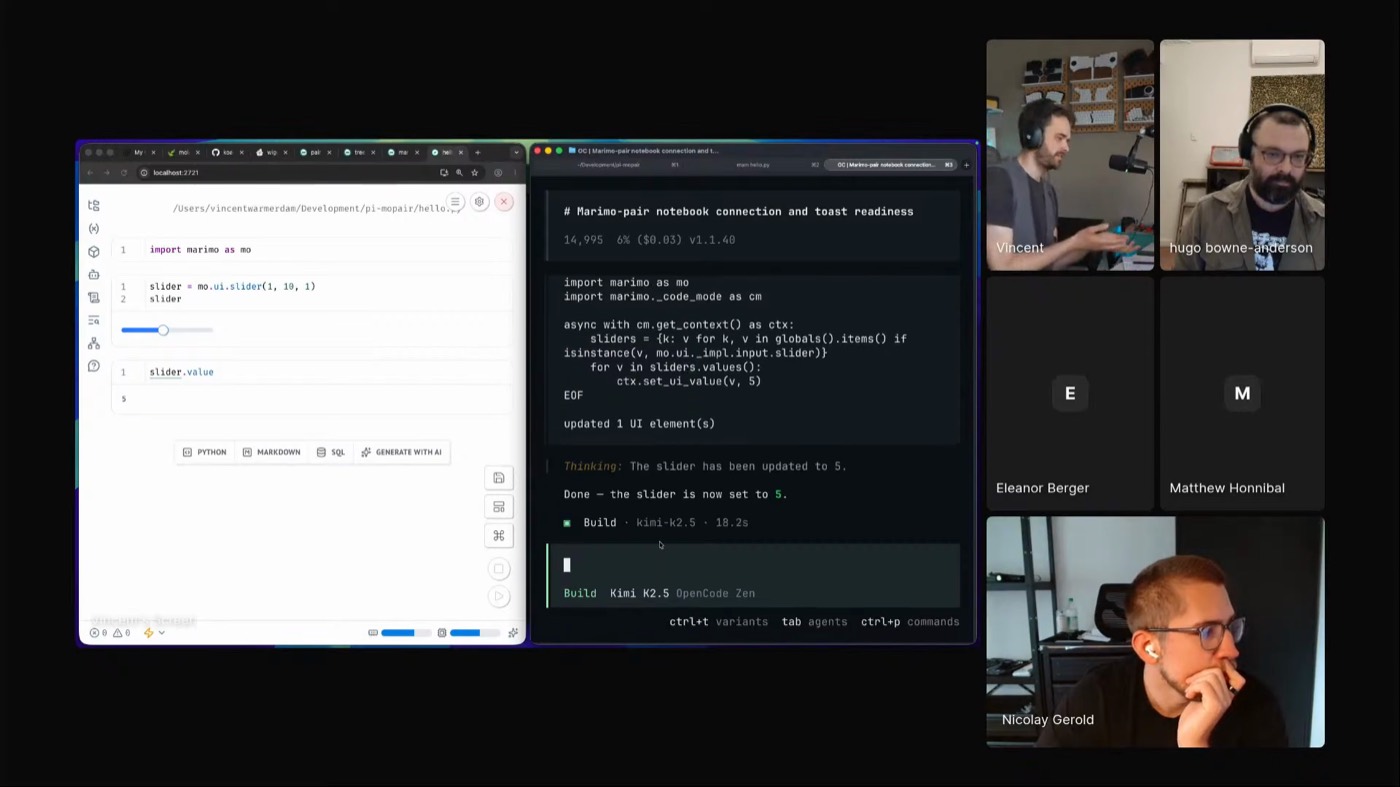
Vincent showing marimo pair connected to a live notebook with a slider value the agent can inspect
marimo pair gives the agent the same live state Vincent is inspecting. The slider is a UI control, a Python value, and an agent-readable object at once. [01:26:04]

"The whole point of a notebook is that I eventually understand something and that's not something the agent can do for me."

The agent can produce code, cards, explanations, and demos. Vincent still wants a surface he can change with his hands until the idea is actually his. 01:14:02

FROM WIDGET TO PAIRING

playful UI pieces, agent-readable docs, runnable demos, live runtime state
Start with suspiciously useful piecesWiggly Stuff brings 3D widgets, graph widgets, zooming, drawing, and Game of Life surfaces into Python notebooks. 01:11:28
Make the docs machine-readableEvery widget has Markdown docs, and llms.txt gives coding agents a path into the library's patterns. 01:11:53
Use examples as style memoryWhen Claude builds another widget, the existing widgets teach the shape, names, and taste Vincent wants repeated. 01:22:48
Make every demo runnableConductor installs dependencies and starts the notebook demos, so each agent iteration ends in something Vincent can open and inspect. 01:22:25
Give the agent the running statemarimo pair opens the scratch pad, exposes notebook variables, and gives the agent a way to act inside the live app. 01:26:05
Put a fence around the notebookMoLab and Pi point toward cloud notebook execution with local file reads limited to the pairing files the task actually needs. 01:28:08

PLAY UNTIL IT CLICKS

Wiggly Stuff makes abstract behavior inspectable and playable

Wiggly Stuff is Vincent's notebook widget library. He calls the components "just a Lego brick": drawing surfaces, graphs, 3D widgets, zoomable views, and demos that also run in Wasm-hosted notebooks.

Draw pixels in a Paint-like widget, let Python react every second, then switch the same surface into Conway's Game of Life.

A straight line and an arc do different things. The user sees the result, changes the code, changes the drawing, and learns from the system pushing back.

A custom drawing widget makes pixels into Python data. A Game of Life loop turns a doodle into behavior. A slider becomes a Python value the agent can read and change.

Vincent, Python, widgets, and the agent keep handing state back to one another inside the notebook.

"I just want normal boring people to exchange notes."

Agent ideas arrive as performance too often. Vincent wants reports from practice, calm demos, and claims that survive a direct check. 01:32:12

THE BORING PERSON WINS

his agent practice keeps evidence louder than performance
UNDERSTANDING
The LLM can generate a deck in seconds. Vincent still writes cards by hand when the goal is memory, because the model cannot know which card is useless for him.
ATTENTION
A weaker, faster model can keep him more engaged. Less trust and shorter waits keep Vincent on his toes, inside the loop, and willing to check the work.
PROVENANCE
Skill files still get handed to an agent. Vincent maintains marimo skills, checks for tampering, and tells users to control where the file came from.
BORING SCIENCE
When demand outruns evidence, gurus appear. Vincent's answer is plain: check whether the thing works, yes or no, and go slowly enough to understand the result.

"It's okay to go slow if it means you understand it better."

Fast prototypes keep Vincent curious and close to the work. If speed replaces understanding, he slows the loop down. 01:35:35